
What do missed calls cost a UK restaurant or takeaway? A worked example
By Kaveh Karimipour, founder of VolaVoice
- Published
- Updated
In short
A missed call costs a UK restaurant or takeaway what that caller would have spent, multiplied by how many missed callers order somewhere else. In our worked example (illustrative inputs, not a UK average) that is £220 a week, or £11,440 a year, in sales. This guide gives you the formula, the example and a 20-minute way to find your own numbers.
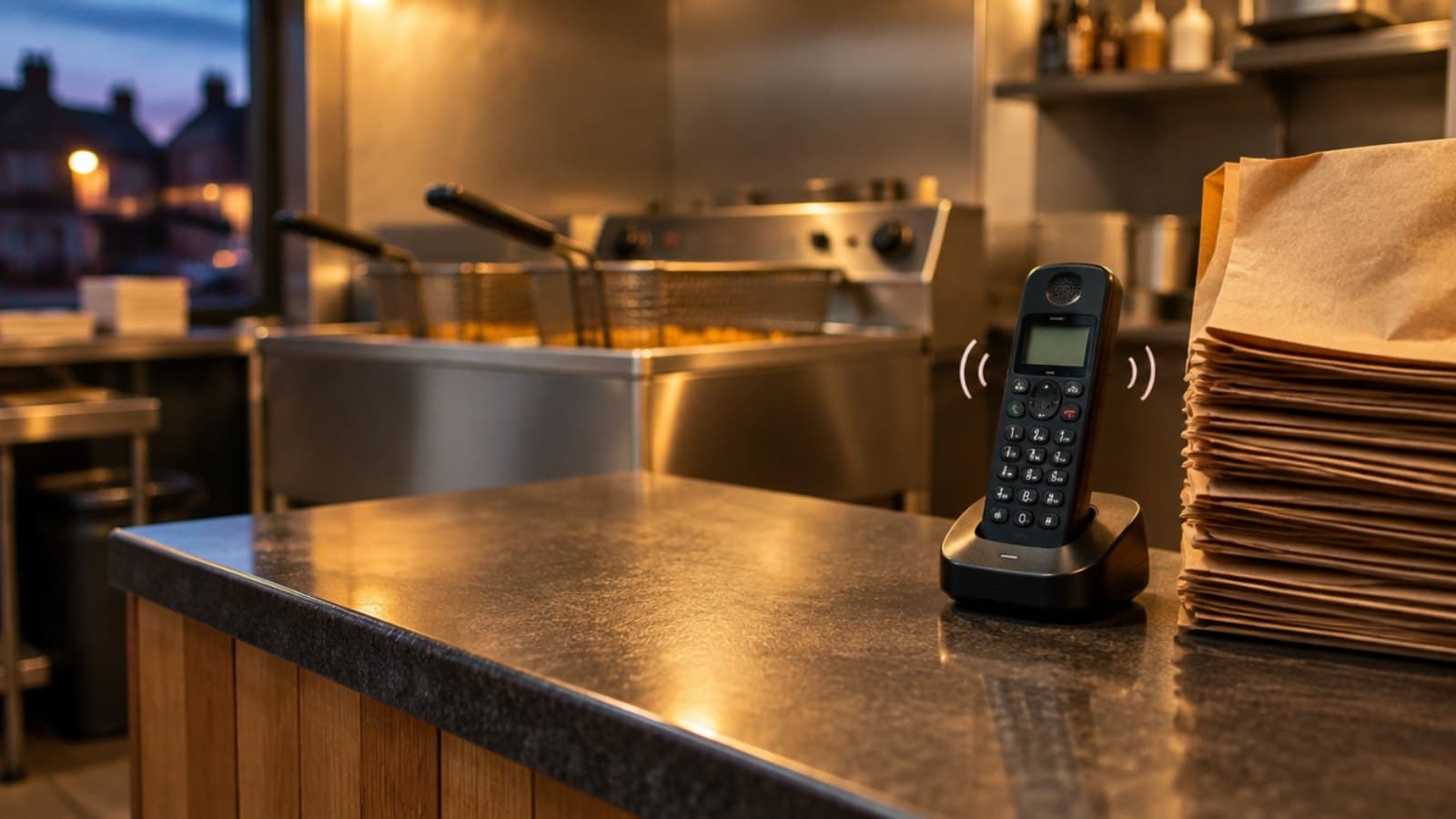
It is ten past seven on a Friday. The fryer is full, two drivers are waiting at the pass and there are four people at the counter. The phone on the wall rings, rings again, and stops. Nobody saw who it was.
Most owners know this happens. Very few know what it costs, because a missed call leaves no receipt. In a June 2026 YouGov poll of 2,046 UK adults, 37% said they would abandon a call to a business within 60 seconds and contact a competitor instead. This guide shows you how to put a pound figure on your own missed calls, using your numbers rather than somebody else's averages.
What do callers do when nobody answers?
Most of them do not wait, and very few leave a message. That decides whether a missed call is a short delay or a lost order.
The YouGov poll above was commissioned by a call answering company, so read it with that in mind. It found that only 6% would leave a voicemail rather than wait, and 24% would switch to another way of getting in touch. Only 26% said they would wait longer than a minute.
Older research points the same way. A 2016 report by Moneypenny, another answering company, combined a survey of 300 UK micro businesses with call data from 10,000 businesses. It found that 69% of callers who reached voicemail hung up without leaving a message, and that 30% of small businesses let calls go to voicemail or ring out.
And the phone still matters for food. In a 2017 YouGov study, 41% of people had phoned the last time they ordered food in, more than any website or app. That figure is old, so treat it as a sign of habit rather than today's share.
For a takeaway, "contact someone else" usually means the next menu in the drawer or an app. The caller was hungry at 7.10pm, not at 8pm when you have time to ring back.
How do you work out what missed calls cost you?
Multiply five numbers you already have. You do not need an industry benchmark:
- Calls a week to your ordering number.
- Missed share: how many of those ring out, go to voicemail or get the engaged tone.
- Order share: how many of the missed calls were people trying to order or book, not suppliers, sales calls or wrong numbers.
- Lost share: how many of those callers ordered elsewhere instead of trying again.
- Average phone order value.
Multiply them together and you have weekly sales at risk. Multiply by 52 for a year.
What does a worked example look like?
Here is the sum with example numbers chosen to show the method. They are not UK averages or benchmarks. Replace every one with your own.
| Step | Example input | Running total |
|---|---|---|
| Calls a week | 150 | 150 calls |
| Missed share | 1 in 5 (20%) | 30 missed calls |
| Order share | Half (50%) | 15 missed order calls |
| Lost share | 2 in 3 order elsewhere | 10 lost orders |
| Average phone order | £22 | £220 a week |
| A year (52 weeks) | £11,440 in sales |
Two things to notice. First, the answer is sales, not profit. Apply your own gross margin after food, packaging and delivery costs to see the effect on your bottom line.
Second, the lost share is the input people argue about most. Some callers will ring back. If you are unsure, run the sum twice, once with a low lost share and once with a high one. If even the low version is worth fixing, you have your answer.
A missed call leaves no receipt, which is exactly why it is so easy to ignore.
How can you find your real numbers in 20 minutes?
You can replace the example figures this week without any new software.
- Your phone's call log. Most mobiles and business phone apps list missed calls with a time. Count a full week and note which evenings the misses cluster on.
- Your phone provider's portal. Many business lines and internet phone systems show answered and unanswered calls. Export a week if you can.
- A tally sheet by the phone. For one Friday and one Saturday, ask whoever is on the counter to make a mark every time the phone rings and nobody gets to it. Crude, but honest.
- Your till or EPOS. If phone orders are tagged as their own channel, it will give you an average phone order value. If not, average ten recent phone orders from your tickets.
- The callbacks you already make. If you ring missed numbers back, note how many had already ordered elsewhere. That is your lost share, measured.
If you would rather try a scenario first, the missed-call calculator on our pricing page works on the same idea, using calls a day and your busiest hours. You can also hear a receptionist built from your own website before you decide anything.
When do missed calls cost the most?
They cost the most at your busiest hour, because that is when misses pile up and when callers most want an answer now. A missed call at 3pm might ring back. A missed call at 7.10pm on a Friday is usually a meal eaten somewhere else.
That fits wider research. A 2026 article by the Contact Centre Management Association reports that more than two thirds of people choose the phone for urgent queries.
So the fix is rarely "answer the phone more". The people who would answer it are plating food and packing bags. You need something that answers when they cannot and hands them the details for when they can.
What does fixing it cost, and what does the number leave out?
Every fix has a price, so weigh it against your own figure. Some examples:
- An extra person on the phone. The National Living Wage for workers aged 21 and over is £12.71 an hour from April 2026. Five hours on a Friday and five on a Saturday is £127.10 a week before employer National Insurance, holiday pay and pension.
- An answering service or an AI receptionist. Our comparison of AI phone answering and a traditional answering service sets out where each one fits.
- Forwarding only the calls you miss. Our guide to UK call forwarding codes shows how to send busy and unanswered calls somewhere they will be picked up, while you still answer the rest.
The formula is deliberately narrow. It does not count repeat custom (a regular who gets no answer twice may stop trying) or the "are you open?" calls that are orders in waiting.
So what is the honest takeaway?
Most takeaways do not have a demand problem on a Friday night. They have a capture problem: the orders are already dialling, and some of them get the ring-out. Work out your own figure with the table above. If it is small, you have lost nothing but twenty minutes. If it is not, it is worth fixing before you spend another pound on marketing.
That is why VolaVoice exists. Your AI receptionist tells callers it is an AI, answers from the information you approve, and captures what the caller wants. It passes order and booking requests to you as awaiting confirmation, so you stay in control of what is promised. It does not read out your menu. Calls are not recorded; you get a transcript and a summary instead. Plans start at £49 a month for 150 minutes, with no setup fee and no per-minute charges, and every plan starts with a 14-day free trial of up to 150 minutes once your number is live. A card is taken when you choose a plan, and you are charged on day 14 unless you cancel.
Hear a receptionist built from your website on the free demo, then decide whether your number is worth fixing.
Frequently asked questions
How much does a missed call cost a takeaway?
It depends on your own numbers: calls a week, the share you miss, the share of those that were orders, the share of those callers who ordered elsewhere, and your average phone order. Multiply them for weekly sales at risk, then apply your gross margin to see the profit effect.
Do customers ring back if I miss their call?
Some do, but many do not. In a June 2026 YouGov poll of 2,046 UK adults, commissioned by a call answering company, 37% said they would abandon a business call within 60 seconds and contact a competitor, and only 6% would leave a voicemail rather than wait.
How do I find out how many calls I miss?
Count a full week of missed calls in your mobile or business phone app, export a report from your phone provider if it offers one, or keep a simple tally by the phone on your two busiest nights.
Can an AI receptionist confirm orders and table bookings?
VolaVoice does not. It captures the caller's details and request and passes it to you as awaiting confirmation, so your team decides what is promised. It also tells callers it is an AI and does not read out your menu.
Sources
- One in three UK consumers will call a competitor if a business fails to answer the phone within 60 seconds (YouGov for Answer4u, June 2026), Pressat
- Small business call report (November 2016), Moneypenny
- Telephone still the single most popular way to order in food (November 2017), YouGov
- Chatbots or humans? What the data says about customer preferences, Contact Centre Management Association (CCMA)
- National Minimum Wage and National Living Wage rates, GOV.UK
How this article was produced
An AI writing tool helped draft this article. A person reviewed, edited and approved it before it was published. The sources it relies on are listed above.