How do UK salons stop missing calls while with a client?
By Kaveh Karimipour, founder of VolaVoice
- Published
- Updated
In short
Start with the free fixes: a voicemail greeting that gives a next step and a website that answers the questions callers ask most. Then cover the calls you cannot take with a person or an AI receptionist that answers from approved information and takes booking requests your team confirms. In a June 2026 YouGov poll, 37% of UK adults said they would give up within 60 seconds and contact a competitor.
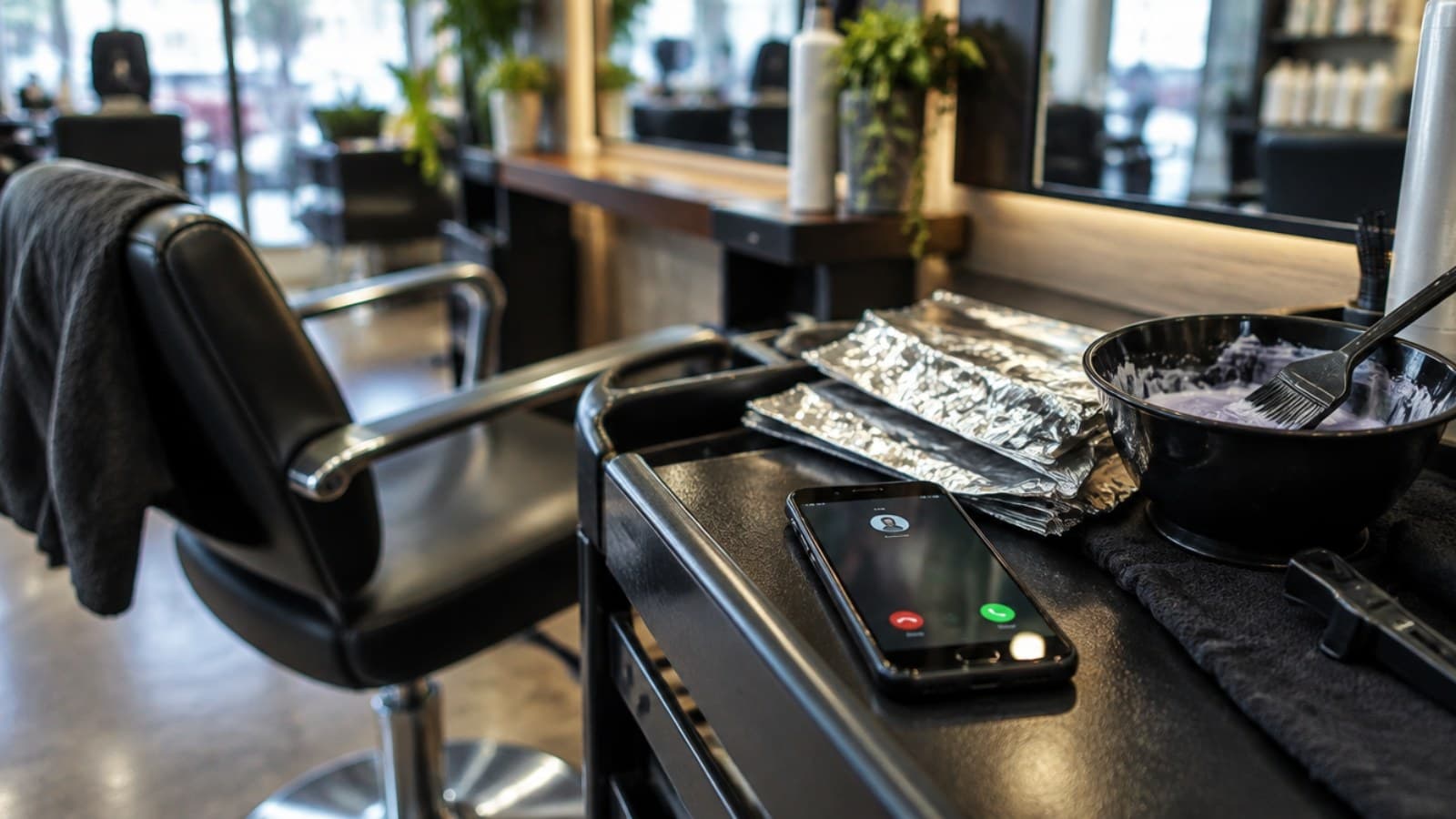
You are halfway through a colour. Foils in, timer running, gloves on, and the phone on the station lights up. You cannot touch it, and you would not walk away from the client in your chair if you could. By the time you look, the caller has gone and there is no voicemail.
For most salons, barbers and beauty rooms this is not a bad day. It is how the phone works. The National Hair and Beauty Federation (NHBF) counts 50,400 hair, barbering and beauty businesses registered for VAT or PAYE in the UK, and reports that around 81% employ fewer than five people. In a business that size there is rarely a front desk. Here is what callers do, what they ask, and which fixes work, starting with the free ones.
Why is the salon phone so hard to answer?
Because the person who would answer is the person holding the scissors, the clippers or the brush. NHBF says 96% of these businesses employ fewer than ten people, so there is seldom a spare pair of hands. Calls do not wait for a gap between clients, and your busiest hours in the chair are often your busiest hours on the phone.
Hiring someone just for the phone is hard to justify when money is tight. In an NHBF survey of more than 430 personal care businesses in April 2025, 21% of salons and barbershops said they were operating at a loss, up from 17% the January before. That is older data, but it explains why a full-time receptionist is out of reach for many.
What do callers do when nobody picks up?
Most do not leave a message. In a June 2026 YouGov poll of 2,046 UK adults, 37% said they would give up within 60 seconds and contact a competitor instead. Only 6% said they would leave a voicemail, and 24% said they would switch to another way of getting in touch.
The poll was commissioned by a call answering company, so it has an interest in the result. The fieldwork was YouGov's and the sample was nationally representative.
One finding matters to salons. Adults aged 25 to 44 had the lowest tolerance for waiting, with only 53% willing to wait for an answer. Plenty of salon clients sit in that age range. A new client who cannot get through is more likely to try the next salon than to leave you a voicemail.
What do callers actually ask a salon?
A handful of questions, again and again. Before you change anything, keep a tally on a sticky note for a week. Most salons find the same list:
- "Have you got anything on Saturday?"
- "How much is a cut and blow-dry, a skin fade or gel nails?"
- "How long does it take?"
- "Do I need a patch test?"
- "Can I move my appointment?"
- "Do you take walk-ins?" and "Where can I park?"
Most of these do not need you at all. They need an answer that already exists in your price list, your policies or your diary. A few do need a person: a patch test, an allergy, a complaint. Keep those in mind, because they matter when you decide who or what answers.
Which fixes cost nothing?
Three, and you can do all of them this week.
- A voicemail greeting that gives a next step. Something like: "Hi, you've reached [salon name]. We're with clients right now. To book, visit [your website] any time. Otherwise leave your name, number and the day you'd like, and we'll call you back between appointments today." Keep it under 20 seconds and only promise a callback you can keep.
- A website that answers the tally. Put prices, how long each service takes, your patch test policy, your cancellation policy, walk-in rules, parking and how to book or move an appointment where people look first. Every question your site answers is a call you do not get, and a question any receptionist can answer properly.
- A set time to ring back. A greeting only helps the few callers who leave a message. Check messages between clients and at a fixed point in the day, and ring back the same day.
None of this costs a penny, and all of it makes whatever you add later work better.
What should an AI receptionist do in a salon, and what should it leave alone?
If the free fixes still leave calls unanswered, something or somebody has to pick up. Your options are a front-of-house person for peak days, a human answering service, or an AI receptionist. Our guide to AI phone answering vs a traditional answering service sets out the trade-offs. You can keep your current number and forward calls only when you are busy or do not answer.
A good AI receptionist for a salon or barber should:
- Answer questions on prices, services, hours and policies from information you approved, and nothing else.
- Take a booking request: the service, the stylist or barber if they have a preference, the days and times that suit, and a name and number.
- Say it is an AI when a caller asks.
- Pass anything it is unsure about to your team, such as patch tests, allergies and complaints.
- Leave you a written transcript and summary of each call.
A client told "you're booked" for a slot that is not in the diary is worse off than one who reached voicemail.
That is why a booking request is not a booking. VolaVoice takes the request and your team confirms it against the real diary. It does not send texts, make outbound calls or take payment over the phone, so deposits and reminders stay with whatever you use today. It keeps no audio recordings, only written transcripts.
Ofcom's September 2026 research on consumers using AI to manage telecoms services found views are mixed: some people prefer dealing with AI, others want a person, especially for complex issues. That was telecoms, not salons, but the lesson carries. A fair set-up respects both. If you want to hear how it sounds for your own business, hear the receptionist answer a call.
The same approach suits other appointment businesses, such as clinics, trades and studios. The salon day is simply the clearest test of it.
So what is the honest takeaway?
You will never answer every call yourself, and you should not try. The client in the chair comes first. Do the free things first: a greeting with a next step, a website that answers the common questions, and a time to ring back.
If calls still go missing, cover them with something that answers honestly and hands your team a clear request. It will not run your diary, and it should never promise a slot you have not confirmed. That gap is why VolaVoice exists. Every plan starts with a 14-day free trial of up to 150 minutes, a card is needed and nothing is charged until the trial ends. You can paste your salon's website into the free demo first, with no account and nothing going live.
Frequently asked questions
How can a salon stop missing calls while working with clients?
Start with a voicemail greeting that gives a next step, a website that answers the common questions and a set time to ring back. Then forward calls you cannot take, only when you are busy or do not answer, to a person, an answering service or an AI receptionist.
Do people leave voicemails for salons?
Most do not. In a June 2026 YouGov poll of UK adults, commissioned by a call answering company, only 6% said they would leave a voicemail rather than wait, and 37% said they would give up within 60 seconds and contact a competitor.
Can an AI receptionist book salon appointments?
VolaVoice takes a booking request with the service, preferred times and the caller's details. Your team confirms it against the real diary, so a caller is not told they are booked before you have confirmed it.
What should a salon voicemail greeting say?
Your salon's name, that you are with clients, where to book online, what details to leave and a callback time you can keep. Keep it under 20 seconds.
Sources
- NHBF industry statistics, National Hair and Beauty Federation
- NHBF survey: 21% of salons operating at a loss amid cost pressures (April 2025), Professional Beauty
- One in three UK consumers will call a competitor if a business fails to answer the phone within 60 seconds (YouGov for Answer4u, June 2026), Pressat
- Consumers using AI to help manage their telecoms services, but human contact still valued, Ofcom
How this article was produced
An AI writing tool helped draft this article. A person reviewed, edited and approved it before it was published. The sources it relies on are listed above.